the net at the end of the world
(written 1997, but unpublished due to the demise of Wired UK- Author: James Flint)
the people
THE TRAIN TO APATITY IS REGULARLY RAIDED BY ARMED ROBBERS. All the other passengers tell you to tie the door to your compartment shut at night because the locks can be manipulated from the outside. Fine. I've done journeys like this before, no sweat. But not in a country where a plastic bag is a valuable commodity. And certainly not with US$200,000 worth of computer equipment stashed beneath my seat.
Apatity is at the mainland end of the Kola Peninsula, a bloated tumor of land that juts out from the back of Scandinavia and crushes the White Sea into a frozen crescent. And with an enormous and largely crippled mining and mineral processing industry and the highest concentration of nuclear reactors of any region in the world, the Kola Peninsula is a potential disaster zone that could could spasm itself into eco-hell at any almost moment.
So what am doing here?
That's the question I keep asking myself.
It has to do with a scheme cooked up in the mind of one Dr. David Probert. David's office is in Reading, England, deep inside the complex that is Digital Equipment Corporation's European headquarters. David, however, is rarely there. Back in 1991, when our story begins, he was Digital's European Business Development Manager, a job which kept him almost constantly on the move and which, in December of that year, landed him in St. Petersburg.
Only four months prior to David's visit Boris Yeltsin had banned the Communist Party and replaced it with a reforming government designed to oversee a move to a Russian free-market economy. Western companies, Digital amongst them, were quick to pounce. Archipelagos of kiosks selling strange mélanges of consumer goods soon choked the sidewalks of Moscow and St. Petersburg. Advertisements went up on street corners. Western-style stores appeared, though no one could afford to shop in them. Macdonalds' "restaurants" popped up in the major cities. Land was bought at knockdown prices. Politicians were sweetened. Undisclosed amounts of cash, art, arms changed hands. Everyone was looking for a way in. David's job was to find one.
Two things were working in David's favour. The first was the fact that in the 1970s and 80s the Soviets had built themselves a tidy little clone industry by shaving down the chips from a few of Digital's PDP 11s and VAX machines and reproducing them exactly. Already familiar then with Digital's technology, the Russians were keen to welcome the company. The second was that since the Chernobyl disaster in 1986 Digital had gained a great deal of experience in setting up radiation monitoring networks throughout Europe. It had worked closely with the German government, amongst others, building the foundations of what the Germans call the "gamma curtain" - an attempt to establish a complete line of networked atmospheric radiation sensors from the very north of the European continent to the south in order to ensure that should any more Chernobyls happen it wouldn't be three weeks before the rest of the world heard about it.
David was therefore on the hunt for someone who might be interested in getting Digital involved in similar operations inside Russia itself; with aging nuclear installations both civil and military all across the country, the government was definitely interested in such monitoring facilities. Amongst the people he was introduced to was one Dr. Alexander Rimsky-Korsakov, son of the great Russian composer Nikolay Rimsky-Korsakov and the Director-General of the V.G. Khlopin Institute of the Ministry of Atomic Energy (aka Minatom). "When I met David for the first time," Rimsky-Korsakov explains with beautiful Russian irony, "I had been more or less active in remote sensing the radiation doses in the great outdoors of our big country." As head of Minatom Rimsky-Korsakov was responsible for keeping an eye on all of Russia's aging civil nuclear powerplants although, thanks to the funding crisis that has affected all government departments since the break-up of the USSR, he wasn't particularly busy. Most of his time was spent arguing against the plans for the national radiation sensor system supported by most of his peers, which involved "connecting every sensor with special wires to a light bulb in some special bunker 1000 miles away." Rather than build something so specialised and expensive Rimsky-Korsakov wanted instead to use a computer network to do the monitoring. Unfortunately the tide of opinion was against him because Russian computers had a reputation for unreliability and other scientists did not believe they would become a mainstream communications tool. "Now it's clear that their approach was crazy, but back then I needed collaboration and understanding from abroad," he says. "David helped me with understanding, energy, and his intent to do something real in Russia. Besides, he is a really nice guy."
At that time Rimsky-Korsakov was collaborating with radiologist Alexander Baklanov of the Apatity-based Kola Science Center (and specifically of that part of it known as INEP - the Institute of Industrial Ecology Problems of the North) to install an Automated System for the Monitoring of a Radiation Situation (ASKRO) in and around the nuclear power plant at Polyarnye Zori, at the heart of the Kola Peninsula. Rimsky-Korsakov intorduced the two men and Baklanov invited David up to Kola for a visit.
David didn't really know what he was in for. Apart from being incredibly remote (it takes 27 hours to get from St. Petersburg to Apatity on the train) back then the entire peninsula was still a restricted zone. A visitor's visa had to be especially issued by the Ministry of Defence, which could take weeks. To get David up there on that first occasion Baklanov had to trick the St. Petersburg Aeroflot office into issuing a plane ticket without the proper documents. Everything went according to plan and they were just congratulating themselves on reaching Apatity and outwitting the authorities when Baklanov got a phone call from a KGB official who told him he it knew exactly what was going on, although he had decided on this occasion not to do anything about it.
The radiation monitoring system being set up by Baklanov and Rimsky-Korsakov around the KNPP was not the only one in the area. The Norwegians and the Finns, terrified of this sword of Damocles dangling in their own backyard, had individually negotiated with the Russian government to place sensor systems of their own inside Murmansk Oblast. Supported by the Swedes and the Germans - these networks were to be part of the "gamma curtain" - the Finns and Norwegians installed their systems. But amazingly they were keeping all the information gathered for themselves. Russian restrictions regarding the transmission of electronic data across borders meant that the Scandinavian scientists were having to go into Kola, take the readings from their systems and ferry the results back manually. Since they were going to such lengths, why should they share? The result was three networks in one area doing similar jobs and yet working completely independently.
David's suggestion - the one which got him to Apatity in the first place - was to combine all of these networks into one and in 1992 on Digital's behalf he signed an agreement with Baklanov and Rimsky-Korsakov to work on a "Quick Response System for Possible Radioactive Emergencies." The first problem the project had was its name: it was too long. So David shortened it to "Kolanet".
But other problems weren't so easily overcome. It has taken David five years to get the project to a point where work on the physical integration of these networks could begin (the work should be completed by the end of this year); what makes this a Wired story is that without the Internet the whole thing would have been dead in the water. What makes it an interesting Wired story is that along the way Kolanet has become about something much more than just radiation monitoring - it has become about education, cooperation and the economic revival of the entire Murmansk region.
I had travelled up to Apatity in the company of Digital employees Peter Szmulik, Victor Rosenquist, and Leszek Kotsch. The US$200,000 of computer equipment was in their care: they needed it to help them with the third of Digital's Internet training courses, which is why on the morning after our arrival I found myself hung-over and helping to drag the suitcases full of hardware like sleds through the deep gully trails that crisscross the snowfields and connect up INEP's buildings. Waiting for us were Nikolay Kashulin and Alexander Perlikov, INEP's scientific secretary and webmaster respectively (and the two men responsible for my introduction to Russian vodka the night before - and thus this morning's hangover) and sixteen students, many of whom are under the aegis of Vsevolod Koshkin of Khibinsky Technical College, a dynamic teacher who has played an active role in Kolanet from the start.
The students are here to learn how to use the Internet facilities that the Kolanet project is beginning to bring into the region. I ask them what they think the impact of Internet will be in Kola, whether or not it will help change the environmental situation. After all, they're taking most of this on trust - the technology is completely new to them. But they have no doubts. Lidia Kempi tells me: "We know that the environmental situation is bad. But the government is doing nothing; Kolanet is the only information we have." Roman Kuritsyn agrees: "We have several environmental groups here, but many companies and the government don't have information on the pollution they causing. I really think the Internet can help this. Just sharing information between monitoring groups and the Institutes will be really effective."
A couple of days later I'm introduced to Professor Gennady Kalabin, director of INEP since its inception in 1989. Kalabin is exactly my idea of a Russian official. He's a powerfully built man, elegantly dressed and gleamingly balding, with a clutch of gold teeth adorning his upper right jaw. I enter his office and there he is, his desk ported onto one end of an enormous boardroom table. His smile is expansive and perhaps a little dangerous. His handshake crushes my hand (I've got big hands).
Kalabin tells me about the many advantages brought here by Net access. The first and most obvious one is also a function of the post-Perestroika attitude to information - the scientists can now receive and publish environmental statistics on an unrestricted basis, and advertise their presence (cheaply) to the rest of the world, so encouraging cooperation with other institutes abroad (since INEP's website has gone up, many such proposals have been forthcoming). But there are other, more basic advantages too. Data which previously would have involved special permits and a trip to St. Petersburg to obtain - and once there a couple of weeks in the library - can now be freely accessed in half an hour. INEP itself is located in a series of small houses and larger buildings, a fact which has made communication amongst the scientists difficult at the best of times. Now they have a local net. They can hire out their new battalion of IT specialists to other companies who want to get wired, and this brings in much needed funds.
Kalabin, however, remains a politician and I suspect that for him the true advantage of being on the Net is that it gives INEP power and prestige with which it can leverage support for its programs. "We are pioneers," he grins. "The Internet gives our institute priority in the region, in the country even. And as our image is growing in the region and the country our weight is growing. This is very important because it means that the government will listen to us, to our problems, conclusions and recommendations."
the place
The Kola region, known to the authorities as Murmansk Oblast (or county), was largely ignored by everybody until the twentieth century. For hundreds of years nobody lived here except a few Russian trappers and hunters and a small group of nomadic Laplanders, the Saami, who followed the migrating reindeer herds throughout the forests and tundra of the peninsula and what is now northern Finland, Sweden and Norway. During World War I pressure from the British - who needed a supply route into Eastern Europe - led to the construction of a port and the founding of the city of Murmansk (about 300 kms to the north of where Apatity is now) in 1915. But the Russians themselves were not slow to realize the advantages of this facility. For the country with the largest land mass of any in the world Russia has an astonishingly small oceanic coastline. To the east there is only Vladivostock, 10 days' train journey from Moscow. To the west there is St. Petersburg, which lets onto the Baltic and is therefore next to useless for ocean access in times of war. To the southwest there is Sevastopol, on the Black Sea, useless for much the same reason though here it is the Dardenelles and Turkey rather than Denmark and Germany which guard the exit. To the northwest there is Archangel, on the White Sea, since the seventeenth century a crucially important trading post for the export of fur, flax, hemp, timber, salt and so on but frozen solid for six months of the year. And that leaves just Murmansk, on the Kola Inlet, at 68 degrees North further north even than Archangel (today, with 450,000 inhabitants, Murmansk is the most northerly city of its size in the world) but kept open all year round by an eddy from the Gulf Stream which wraps itself like one of Gaia's central heating pipes all the way along this coast up to Novaya Zemlya.
Once Murmansk was founded and the railway was built linking it with St. Petersburg it was soon discovered that the Kola Peninsula is enormously rich in natural resources. Apart from over 100,000 lakes and rivers full of trout and salmon, a sea full of herring, cod, haddock, capelin and perch (herring hauls were 10 million tons annually between 1950 and 1970) and vast forests of Scots pine, spruce, birch, aspen and alder, buried in the Kola landscape are over 700 different types of minerals - that's over a quarter of all known types of minerals in the world. Here there are major reserves of phosphorus, iron, copper, nickel, cobalt, sulphur, aluminum, titanium, vanadium, sodium, potassium, zirconium, niobium and tantalum. And offshore there are oil and natural gas deposits to rival those exploited by Britain in the North Sea throughout the 1980s.
No surprise then that Stalin should have decided to exploit the area. The Saami population was rounded up and effectively imprisoned in large and crumbling housing estates where many of them remain today - although increasingly they are returning to their old fishing villages along the south coast of the Peninsula - and the region was seeded with gulags, whose inmates built and ran the factories and mines in appalling conditions (average life expectancy was about two years). This was an industrial revolution: all that mattered was the stoking of the tumescent Soviet machine, and the scale and speed of industrial expansion were extraordinary even though summer lasted about a month and where the inland temperatures regularly dropped in winter to minus 40 Celsius.
After World War II, the whole area
became a military industrial zone and a playpen for atomic scientists.
Nuclear testing on the nearby island of Novaya Zemlya began in 1955 (after
the small indigenous population of aboriginal Nenets were, like the Saami
before them, forcibly relocated) and included both atmospheric and
underground tests. The Soviet Navy's Northern Fleet made its home here and
now has twenty bases on the coast of the Kola Peninsula. Nine of these
house nuclear submarines and surface vessels - the Fleet got its first
nuclear sub in 1958 and now has 83 more, as well as two nuclear powered
cruisers (that's 161 reactors in all). Then there's the world's largest
civil nuclear fleet, Atomflot, which today consists of 8 nuclear powered
icebreakers whose job it is to keep the sea-passage to Archangel open in
winter, one nuclear powered container ship and five ships full of
radioactive waste which just sit and rot in Murmansk's
harbour.
Trouble is, this stuff is just not safe - and never has
been. Information about 52 known accidents and incidents involving the
submarines of the Northern Fleet and the icebreakers of Atomflot has been
detailed by the Norwegian environmental foundation Bellona much of which
has been made available on the web
(www.ngo.grida.no/bellona/ehome/index.htm). To give you an example, the
oldest of the icebreakers, the Lenin, suffered a major leakage in the
cooling system of one of its reactors in 1967. The reactor section was
contaminated and had to be replaced. The ship was towed out to the Kara
Sea (east of Novaya Zemlya) where its three reactors were dumped on the
seabed; it was then refitted. This kind of activity was relatively
common.
According to Alexander Baklanov's own report for the International Institute of Applied Systems Analysis (IIASA), "the former Soviet Union has dumped into seas more than twice as much radioactivity as other countries. Since 1960 the Russian Northern Fleet has dumped radioactive waste in the Barents and Kara Seas on a regular basis. This comprises solid nuclear waste, liquid nuclear waste and nuclear reactors with or without solid nuclear fuel. Furthermore, raw waste has been dumped in the Barents and Kara Seas from the civil nuclear icebreakers of the Murmansk Shipping Company." Inland, the picture is much the same. There are nuclear weapons storage sites and bases for nuclear warheads, radioactive waste depositories and spent nuclear fuel storage facilities (most of which have experienced accidents and leaks of their own and are presently falling into disrepair) and of course the nuclear weapons test range on Novaya Zemlya (which on one memorable occasion spread radioactive fallout all over Europe).
On top of that is the legacy of the civil explosions. Kirovsk, a town not far from Apatity and Russia's number one ski resort also boasts the world's largest opencast mine. In the early 1970s, someone somewhere who was rushing on the amphetamine possibilities of Soviet "economic achievement" decided it would be a really good idea to use a nuclear device to speed up the extraction of the apatite ore that is found in abundance in these mountains. (Apatite, from which Apatity gets its name, is used in the manufacture of aluminum). The idea was that the shockwave from a buried bomb would shatter the surrounding rock whilst the explosion itself would melt the immediately surrounding rock into a glassy sphere that would contain the most harmful radionuclides long enough to ensure their decay. That's the theory. In practice, leakage nearly always occurs which, apart from causing general environmental damage, can contaminate the very ore the operation was supposed to release. The use of nuclear explosions for mining was so potentially damaging politically that after Perestroika many records were "lost", and with them several warheads. They're buried somewhere in the mountains, ready for detonation, but no one knows exactly where.
A blizzard prevented me from visiting the mine but I did manage to get a tour of the Kola Nuclear Power Plant (KNPP). The plant is about an hour's drive from Apatity. You follow the Murmansk road out of town, crossing Lake Imandra at the corner of its 200 km right angle. It's April, and winter's outstayed its welcome this year - there's still a good one or two meters of snow on the ground. The roads, even the main roads, are still coated with a thick layer of ice though. Victor our driver has two speeds: insane and skid. But he seems to know what he's doing. I hope he knows what he's doing.
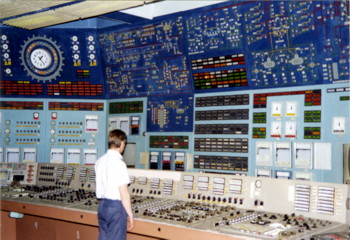
The first two reactors at the KNPP were installed in the early 70s: they are first generation pressurized water reactors, much like those at Chernobyl, and share similar design faults. Two more reactors of a slightly improved design were added 10 years later. The plant supplies 60 to 70 percent of the total energy requirements of the Murmansk Oblast, and is therefore indispensable to the region. Unfortunately, the International Atomic Energy Agency (IAEA) reckons that there's a 1 in 4 chance of a meltdown in one of the two older reactors over the next 23 years. The Norwegian government claims that the plant nearly suffered a meltdown in February 1993 when backup power to the cooling systems failed. Thankfully, the Norwegians do more than just complain - as a result of this incident they gave the KNPP two new diesel generators to replace the ones that had failed and enhanced the antiquated control room with half a million dollars worth of computer systems - which hook into the same monitoring network that Baklanov and Rimsky-Korsakov were setting up here. The generators arrived recently and are now installed - along with many other safety measures - although they had to sit in Russian customs at the border for 18 months until the plant could raise the money to pay the import tax of 40 percent. This is new Russia - there is no money and no tax break, not even for ailing power stations.
But risk of radiation pollution is only half the problem that Kola faces. While atomic energy supplied the energy for the region's modern economic development, the industries themselves have scrawled their own signatures of damage across the Kola environment. These divide into roughly two groups: heavy metal pollution in many of the rivers, lakes and forests due to extensive the mining and mineral processing activities; and chemical contamination from industrial installations
Let me tell you about the factory town of Monchegorsk. Monchegorsk is about a third of the way along the 300km bobsled run that links Apatity with Murmansk. It's home to the Severonikel Kombinat plant which produces nickel and copper, one of two such plants in the region (the other is in a town called Nikel, on the Norwegian border). Like every other part of eastern Kola, the area around Monchegorsk is covered with a thick carpet of pine, spruce, birch. Or rather, it should be. The airborne pollution is so bad that about 30 kilometers from the town the trees start to die. Go another 10 kilometers in and there is nothing left alive. The people round here call it the moonscape. In summer the soil is blue from the deposited heavy metals. When we left Apatity the sky was azure, clear, crisp, and the sun bright and hot. But not at Monchegorsk. Here you can hardly see the sun because of the thick brown pall of sulphur dioxide that stretches for miles and miles and miles and which - when it combines with the similar cloud emitted by the Nikel plant - affects about half of the entire peninsula, not to mention a large tract of Norway. Stand outside and your lungs tighten and you can feel the air puckering your face. There's so much sulphur dioxide in the air that all the metal pylons in the area have rusted clean away and have had to be replaced with wooden ones.
The population of Monchegorsk is 70,000. The average life expectancy for a plant worker is 45 and a high proportion of children are born with deformities or pollution related diseases. In the good old days, this fact could be swept under the carpet by the authorities - the plants paid well, and workers would come up here for ten or fifteen years, make a packet, then retire with their family to some dacha back down south where they would quietly die of emphysema or some such thing a few years later. But now the economy has collapsed no one can afford to leave and the social costs of these plants have become horribly apparent. The people who live here face a stark choice - suffocate, or starve.
On the return journey from Murmansk I convince Victor to drive closer to the factory and let me take some photographs. Evening is approaching; only a few days previously the clocks went forward and the long arctic twilights which over the next two months will lengthen until they displace the night altogether have begun. But as we turn off the main road and head towards the factory the sky gets darker still.
We cross a bridge and I pull out my camera, eager for the first shots of this belching behemoth which now dominates the horizon. But the other passengers start hissing at me police, police, so I quickly sit down and drop the camera out of view. We pull up to a checkpoint: KGB. Most towns up here have checkpoints; most of them are manned by the GAI - the traffic police. Monchegorsk is still sensitive enough to have a KGB presence. No one had told me this. But we pass without incident and Victor heads in the direction of Severonikel Kombinat. It's huge, itself the size of a small town. This is the Zone: it's like a scene from the Tarkovsky movie Stalker. The entire area is strewn with debris. The rusting bones of dead machinery poke up everywhere through the blackened snow. Overhead, lines and wires form a lacy chaos; on the ground, railway tracks and sidings twist and squirm. Buildings which should have been condemned long ago spurt fumes from every orifice. Chimneys - I count 13 in all - leak pollutants from the entire length of their columns. We pass the main office - there is grass out front. I'm told they have to re-turf this every year; not just the grass but the soil as well, to the depth of a meter.
Every time we're out of sight of the checkpoint Victor stops the van and I jump out to get some pictures, a process which becomes increasingly difficult due to the fact that we are now being tailed by a snow plough. We stand around until it has passed, relieving ourselves into a snow bank, then disappear up a side road. Then Victor decides he doesn't want to go back out past the checkpoint. He knows a shortcut, he says. So he turns off the road and heads down what he thinks is a track and what the rest of us think is a snowdrift. Thirty seconds later even the insuperable Victor is out of his depth. We are stuck. Suddenly, for the first time, I'm scared. This is it. I'm here for the night in the most polluted place on the planet with a roll of illegal film in my pocket and the KGB on my case. I've been told stories about what they do to environmentalists discovered trying to take soil samples around here. Put it like this: if we're caught, it won't be pretty.
The only way out is back the way we've come, back up a ridiculous, snow bound incline. Victor, sublimely unperturbed, tells us all to get out and takes it at speed. On the third attempt he gets the van up the slope and we're back in business. The first thing we see is the snow plough. Out of the frying pan and into the fire. But we outrun it and then we're broadside on the plant, below a parapet. It's the opportunity I've been waiting for. Victor stops the van and I run up a snow bank to the top of the concrete wall. For the first time I can see the whole thing. It's a nightmare. I can't describe it. Eco-hell. I get off seven or eight shots before the van's horn sounds behind me. Don't know what's wrong but don't wait to find out: I tumble down the slope and into the van, and we drive off. It was the snow plough - it had caught up with us again. The driver must have seen me this time. We drive like crazy for the checkpoint, hoping that he doesn't have a radio. I take the film out of my camera, swop it for a blank just in case. We hit the checkpoint, wait. It's okay, we're waved through. We slalom across the ice and get back onto the main road. We're out of there.
the project
When it became clear that there was
an investment opportunity here for Digital, the first thing David did was
finance the creation of a computer laboratory for INEP. Digital invested
the grand sum of US$5000 in this, which at the time had the buying power
of a thousand times that amount and paid for a new roof on the building
and its complete refurbishment. The laboratory opened on April 24, 1993,
the day before the ill-fated Russian elections which led, in an unsettling
twist, to Yeltsin himself sending tanks to blockade the White House. In
November, following the arrest of the rebel leaders Rutskoi and
Khasbulatov and with some measure of calm once again restored to the
political situation, Digital put a donated Alpha server into the new
laboratory and hired some of the INEP staff to translate some computer
courses into Russian. The idea was to train up some people on the ground
in network skills so that when the time cam they could help coordinate the
project from the Russian end.
Now that the project had a base the
next step could be taken, which was to convene what would become the
Kolanet Committee. But this was no a simple matter. In Russia there are
three separate ministries that have some sort of responsibility for
monitoring radioactivity. Apart from Minatom, which actually owns the
nuclear power stations and has responsibility for all monitoring within a
30 km radius of the sites, there's the Ministry of Meteorology and the
Ministry of the Environment. "So you haven't just got Norway, Sweden,
Finland and Germany, you've got these three political forces as well, all
with their own ambitions to build a network," David points out. "Oh yes,
and these 3 are replicated not just nationally but regionally as well."
Partly because of intense competition between such bodies for all and any
funding, and partly just because of the atmosphere of inter-institutional
hostility that is legacy of Soviet rule, trying to get all of these
interests to cooperate must have felt at times like trying to achieve the
political equivalent of nuclear fusion.
At this stage the plan was
to build Kolanet using the packet-switching network technology known as
"X25" that Digital had used in the past to build the radiation monitoring
networks in Germany and the Czech republic. X25 needs its own
communications links, which are expensive, and as Rimsky-Kosrakov points
out "There was no money in the budget. Period." Despite all its good
intentions, the Kolanet project looked all set to founder. Even if a
willing sponsor could have been found, funding a big project like this in
Russia is not as straightforward as it is in, say Germany. Corruption is
extremely rife. "It's not a good idea to put a lot of cash in Russia,
because it isn't spent on what you think it's going to be spent on," David
quietly remarks.
And then, in July 1994, David was made Director of European Internet Business at Digital and with the new job came a new idea - why not build Kolanet using Internet technology? Back at Kolanet's inception in 1991 using Internet had been out of the question. Apart from the lack of computers, the telephone system was diabolical, just good enough for limited email, but not for any kind of significant data transfer.. In Apatity, a town of 80,000 people, phone numbers have 3 digits, which gives you some idea of its immediate limitations. If you call Kirovsk, the nearest town, you have to shout down the phone to be heard. To call St. Petersburg, at least in those days, you had to book the call. To call internationally - well, forget it. The Kola region has a 1000 km border with Finland, the most wired country in Europe and possibly in the world, and you couldn't make an international call.
But by 1994 the situation looked like it might change. A fiber-based telecoms backbone was being put into the region by a new company called Kola Telecom, set up the previous year as a joint venture between TeleNor (Norwegian Telecom) and Murmansk Telecom. Spurred on by this activity, the local electrical company had also decided it could profit by getting in on the telecoms scene and was beginning to put in wrapped fibre cables alongside the high voltage masts to all their main facilities - including the KNPP itself. If Kolanet could piggyback on these new systems, there would be no need to raise money for a network infrastructure and therefore no need for a major backer.
Seeing the opportunity, David didn't hang around. Digital's Paris laboratories were being relocated at the time and suddenly he had a whole load of equipment on his hands in need of a home. What could be simpler? He requisitioned the 15 or so DEC stations and gave one to each institutional member of the Kolanet committee and organized a 3 week training course to bring them all up to speed on Unix, html, networking infrastructure and so on. "It was just a brainwave. I suddenly had all this computing technology and I said well, let's use it for Kolanet, to give it a spark of life."
And yet, what was the use in teaching these skills if there was no network back home to use them on? But there was a network of sorts in Apatity - in fact there was a 64 kps satellite link between Oslo and Apatity set up, believe it not, by the Advanced Research Projects Agency, or ARPA. That's right. The same guys and gals who invented the Internet. Dug into the bedrock just outside of Apatity are several massive seismic sensors which monitored, amongst other things, the SALT 2 test ban treaty and Japanese and Chinese nuclear tests, and it was data from these that was going over the satellite link (the Norweigian Satellite Array (NORSAR) dish, perched atop a residential block, reminds you just how far north you are - the dish actually points downwards, at the horizon, where it can just pick up the satellite which hovers there above the curl of the earth). By 1994 the ARPA project was completed and 1995 the Norwegian Ministry of Foreign Affairs agreed to let the KSC make use of the link. Not long after that the first INEP website went up (New Mirror Site: http://www.valentina.net/am/inst/ksclink.htm).
And then, in June of that year, when spring (which lasts about three days) had come and gone and the short summer was in full swing, the first full meeting of the Kolanet Committee took place. About 25 people attended including representatives from Norway, Finland, Sweden and Germany, from all major governmental institutions involved, from Petrozavodsk University in Karelia and from the Khibinsky Technical College in Kirovsk. "The first meeting was difficult," recalls David. "It was the first time all of these different interests had been brought together to discuss the situation. There was a lot of tension in the air. I remember particularly the Murmansk Nature Committee and the Meteorological Committee were just daggers drawn." Kolanet had been in the pipeline now for over four years and now with the application of Internet technology looked liked being really viable for the first time. But that also meant that now there was a great deal at stake. Building a successul network throughout the region didn't just mean being able to monitor radiation - it also meant access to technology and access to power.
But amazingly the meeting was a success. The committee agreed that they should link up the Finnish, Norwegian and Russian sensors and that the information should be shared. There was still some sensitivity over who should get the data first - the Russians wanted to censor it before it went off abroad in case of false alarms (a very real danger, in fact) - but "there was a growing realization that because of the economic situation and the scarcity of money and resources it made more sense to pool it all together." Kolanet was quorate and online. It had taken two and half years of negotiations, but now it was a reality. Just ten years ago all environmental information in the USSR - even meteorological information - was highly classified. Now, thanks to the Kolanet initiative, one of the most ecologically endangered regions in the world is finally going to get proper information about the extent of the dangers which face it made publically available.
the upshot
Even before the radiation networks have been hooked up, plans are afoot to expand Kolanet's monitoring abilities.Baklanov and Probert are keen to get a network of automatic sulphur dioxide sensors and even heavy metal sensors set up, although this would be expensive and Kalabin is hesitant about the project, thinking that the radiation network is probably enough of an achievement for the time being. But even without the other types of sensors Kolanet is still extremely important for the environmental future of the peninsula simply because INEP is the one organisation in the committee holding all the cards. At the moment they have all the technology and all the expertise. If anyone else in the region wants to get trained up on this stuff then they have to come to an environmental scientist, and you can bet they won't leave without a generous helping of ecological good sense served up alongside their IT.
The timing is crucial. Russia is a country that is completely reinventing itself and having to overcome massive difficulties to do so. People in the West often talk about introducing capitalism as if it's some kind of tap that can be turned on and left to run. But there is no culture of buying and selling here; there is no managerial class, no bourgeoisie - the Communist revolution was real after all. There is an enormous suspicion of making money out of something you have not made yourself. Very few people have even the remotest idea of what it takes to set up and run a small business, and the people who do manage it are often classified as "mafia" even though they are a far cry from the gunslinging hoodlems also called by that name. Business and information structures of all kinds are being invented from scratch, and there is no doubt that something new is developing here - techniques and expertise from the West, while useful, are not directly transferable.
It's also going to be some time before things get up to speed. In Apatity most of the people who make up the current "middle classes" - the scientists themselves, the doctors and nurses, the teachers, the government officials (a category that ranges much wider than it does in the West) - haven't been paid for up to a year. People turn up to work everyday because if they didn't their town would collapse. The entire community subsists on a grey economy of goodwill, barter and constantly reinvented community. Take Victor, who's a good example of how this system works. I never found out what Victor used to do, but now he seems to be INEP's official driver. When you want to go somewhere, Victor takes you, and anyone else who wants to come along. It's kind of a private bus service. Victor drives better than anyone else, so he drives, and his mobility means he can double up as a salmon distributor - the trips to Murmansk were always punctuated with stops at various fish stalls run by local fisherman, where a furious barter generally ensued. In return for these services he becomes part of the mutual support system of housing, food, favors, that INEP maintains amongst its own. There's an old Russian saying that Vsevolod Koshkin passes on to me and which nicely sums this up. It goes: "I may not have 100 roubles, but I have 100 friends."
Which is why it's so significant that an environmental organisation has its hands on the reins of IT in the Kola peninsula. Look at their website. Already Murmansk's North Chamber of Commerce and Industry has space on the INEP server and nearly seventy companies have posted their details. Every day INEP gets more enquiries from people trying to get online. The mining company in Kirovsk for example, who have a computer already but need to be able to communicate with their superiors in Moscow. Or the fishing fleet, who are considering selling the data their 300 odd ships collect on fish movements to the Norwegians, for fish forecasting purposes. How these companies behave towards the environment over the next few years is going to be a decisive factor in whether or not the Kola Peninsula becomes a gold mine or a horror story - the fact that they now have close ties with INEP can only be a help.
There is an atmosphere of tremendous excitement here in Apatity. So much of life in Russia seems unsure right now: no one is really in charge, new ways of life are having to be invented on the fly, no one is quite sure what the future holds. But the people at INEP have a sense of purpose, a mission. In many ways, this group of environmental scientists holds the key to the future of the region. Not only are they the only people who understand the ecosystem and how it can be exploited without damage, but now they are the people who are sitting pretty with the communications technology that can open Kola up. There's still a long way to go - it's been eighteen months since the Kolanet's satellite link was garnered and the radiation data has not yet been integrated. But when it's complete, the Kolanet project may just be one of the finest examples in Russia of how intelligent investment, local initiative, and bottom-up organization can begin to help turn an apparently hopeless situation around. Maybe Gennady Kalabin puts it best. "Now," he says with a smile, "we are part of the whole world."
